Bodies, buildings
‘I quickly realised the more truthful I try to be in language, the more I lie. One immediately comes up to language and learns either to be defeated or to let language fuck one, to fuck with language’.
—Kathy Acker, ‘Politics’ 1
i
have a crush. a
literary
crush.
not with an author, per se.
not even with a fictional character.
but with a piece of writing itself.
with a textual body.
Whether or not it’s subversive or simply downright perverse to fancy a piece of art, for the past three years, I’ve had somewhat on-again, off-again, let’s call it a relational obsession with the late iconoclast Kathy Acker’s 1993 essay, ‘AGAINST ORDINARY LANGUAGE: THE LANGUAGE OF THE BODY’ 2.
I type it here capitalised because that’s how it appears in Yvonne Buchiem’s free online PDF, my go-to, with little wings around it.
Said relational obsession began during the first year of my MFA, in late 2021. I’d never heard of Acker before a classmate mentioned this particular essay, quoting it as being formative for a piece of work where they had built a giant 5-foot functioning arsehole out of a partition wall, zipped themselves up into a brown sleeping bag and then continually shat themselves through the wall for an hour straight.
My opinions on originality aside, obviously, I had to read the essay.
Enter Yvonne Buchiem’s free online PDF and there’s your meet-cute.
~
Acker's essay begins with her describing that for some time, she’s been unsuccessfully trying to write about her personal experiences of bodybuilding. Acker explains that despite having been bodybuilding by this point for the better part of a decade, ‘time and time again’, whenever she puts pen to paper after being in the gym, she fails to write — observing that
have a crush. a
literary
crush.
not with an author, per se.
not even with a fictional character.
but with a piece of writing itself.
with a textual body.
Whether or not it’s subversive or simply downright perverse to fancy a piece of art, for the past three years, I’ve had somewhat on-again, off-again, let’s call it a relational obsession with the late iconoclast Kathy Acker’s 1993 essay, ‘AGAINST ORDINARY LANGUAGE: THE LANGUAGE OF THE BODY’ 2.
I type it here capitalised because that’s how it appears in Yvonne Buchiem’s free online PDF, my go-to, with little wings around it.
Said relational obsession began during the first year of my MFA, in late 2021. I’d never heard of Acker before a classmate mentioned this particular essay, quoting it as being formative for a piece of work where they had built a giant 5-foot functioning arsehole out of a partition wall, zipped themselves up into a brown sleeping bag and then continually shat themselves through the wall for an hour straight.
My opinions on originality aside, obviously, I had to read the essay.
Enter Yvonne Buchiem’s free online PDF and there’s your meet-cute.
~
Acker's essay begins with her describing that for some time, she’s been unsuccessfully trying to write about her personal experiences of bodybuilding. Acker explains that despite having been bodybuilding by this point for the better part of a decade, ‘time and time again’, whenever she puts pen to paper after being in the gym, she fails to write — observing that
the ‘I’ who bodybuilds… was rejecting language’.2
Throughout the text Acker ponders on this conundrum, critically engaging with why the material act of bodybuilding seems to transcend verbal language — why bodybuilding seems indescribable using, what Acker calls, ‘ordinary language’.
‘If ordinary language or meanings lie outside essence, what is the position of that language game which I have named the language of the body? For bodybuilding (a language of the body) rejects ordinary language and yet itself constitutes a language, a method for understanding and controlling the physical which in this case is also the self.’ 2
On one, simplistic level, the text can be read as a criticism of cartesian readings of the body — that is, that there exists a dualism between the cognitive mind and physical body.
But for Acker? Way too reductionist.
This was an exercise, literally, in finding a new route for expression. Namely, expression that isn’t delimited by knowledge. Bodybuilding opened, as language can, a new form of world-making, possibility, vision.
My interest in this text was initially purely academic, which made perfect sense; Like Acker, I’m a writer, an artist. Tick. My work also explores the boundaries between subjectivity, corporeality and linguistics. Tick. I’d also recently gotten into bodybuilding. Double-tick.
But arseholes aside, there was one irreducible similitude between the text and I.
my body was also rejecting language.
It had started quite suddenly. The visceral recoiling at she’s and Ma’ms. The sudden jolt at gendered colloquialisms and terms that had been used to describe the sum of my parts for 27 years. Suddenly, the I looked wonky, off-kilter.
I began obsessing over the text. Blue-tacked printouts, with scrawled notes grew like vines over my studio walls. Sticky notes with quips and quotes lined my laptop carry case. I wrote outtakes in the shower with my finger pressed on the steamed-up glass. I rolled prose out in my head whilst my barber shaved it. Highlighted passages would pop up like intrusive thoughts everywhere. Everywhere that is, except the obvious place — the gym. I too began to wonder if ‘ordinary language’ was eluding me.
Embarrassingly, for all of my readings, re-readings, ponderings, musings — I didn’t have single a fucking clue what Acker was talking about. Beyond the blindingly obvious, the core conceptuality of the text was lost on me. The language felt too complex, too weighty. The references to Canetti and Wittgenstein I just couldn't grasp. Its subtle nuances and subjectivity were too slippery, the dots, subtracting.
One at this point, months deep, might think — here lies the limit to my understanding. After all, Acker was a voracious reader of philosophy and these were not easy concepts. Perhaps I’m overthinking it? Perhaps this isn’t the kind of literature for me. Perhaps I am just a woman. A vagina and legs.
But there was something in these words I couldn’t let go of. I knew the key to my body's corporeal word vomit recoil lay here. So I lent in more.
I read more Acker, her other essays, plays, novels. I didn’t understand those either. I read her references, sources, listened to talks about her work by distinguished academics and writers — to no avail. I made the 1993 essay the focal point of a seminar presentation, referenced it in an artist talk and discussed it at length with my MFA tutor — all the while too embarrassed to ask the one simple question that would put me out of my intellectual misery — what the fuck does all this mean? Like the ex that just won’t text you back, Acker was giving me sweet nothing.
~
Acker infamously stole from other writers. Whole sections of some of her works are paraphrased from other people's, ‘copy and pasting’ characters, plotlines, quotes. This plagiarism, as Acker later provocatively came to define it, became the hallmark of her fiction. She did this unapologetically — using it as a conceptual method to challenge the repressive socio-political structures that insist we occupy simply one bounded self. As Maggie Dohert wrote in the New Yorker, ‘Her fiction asked not “Who am I?” but, rather, in a more philosophical key, what it meant to have an “I”—or several’ 3.
So maybe, I figured, I’m asking the wrong questions. Maybe it isn’t ‘what is this text trying to say’, but rather, ‘what does it mean to be in possession of this text’? Perhaps the last bastion of hope for me to understand Ackers words is to take a leaf out of her book, quite literally — to steal them.
Face to Face with chaos
all eyes on my failures
arms outstretched to oblivion
i yield, i grow
all eyes on my failures
arms outstretched to oblivion
i yield, i grow
This is the passage that I, not quite so provocatively, plagiarised (let’s call it appropriated), the original reading:
‘To come face to face with chaos, with my own failure or a form of death’ 2.
Taken, of course, from the 1993 essay, these words are from a section where Acker details the concept of pushing to failure within bodybuilding. ‘Failure’, is the term used for when your muscles have been worked up to the point where they physically can’t move any more weight. This process is necessary in bodybuilding to elicit hypertrophy, the building of more muscle.
In order to grow a muscle, one must first break the muscle down. You want to do enough reps that you physically can’t do any more, but you don’t want to hurt or injure the muscle. To do this you must strive for ‘perfect form’ — that is, carrying out the movement in its most optimal pattern to target that muscle or muscle group. In other words, ultimately, you’re constantly striving to fail in the face of perfection.
~
My appropriated text was digitally printed in the black font Cormorant Garamond, on four 3m by 90cm white cotton sheets, one line of text per sheet, and presented like a concrete poem.
The sheets were suspended from the ceiling with steel wires and left to dangle with the bottom edges sitting around 1m above the floor. Below the sheets sat four grey, plaster cast troughs, which at first glance look like they could be concrete. The troughs were situated underneath each suspended sheet, as if ready to catch the tumbling words.
The first trough, laid under the first sheet, which read ‘Face to Face with chaos’, was fully intact.
The second, under ‘all eyes on my failures’, was slightly broken around the edges, visibly marked and cracked.
The third, ‘arms outstretched to oblivion’, was almost entirely destroyed, smashed into separate chunks dispersed within about 1m of the base of the work.
The fourth trough, underneath, ‘i yield, i grow’, was again fully intact, but instead of sitting parallel to the base of the cloth like the previous troughs had, this one was pointing at an obtuse angle, toward a new direction.
The piece was titled, ‘OBLIVION’.
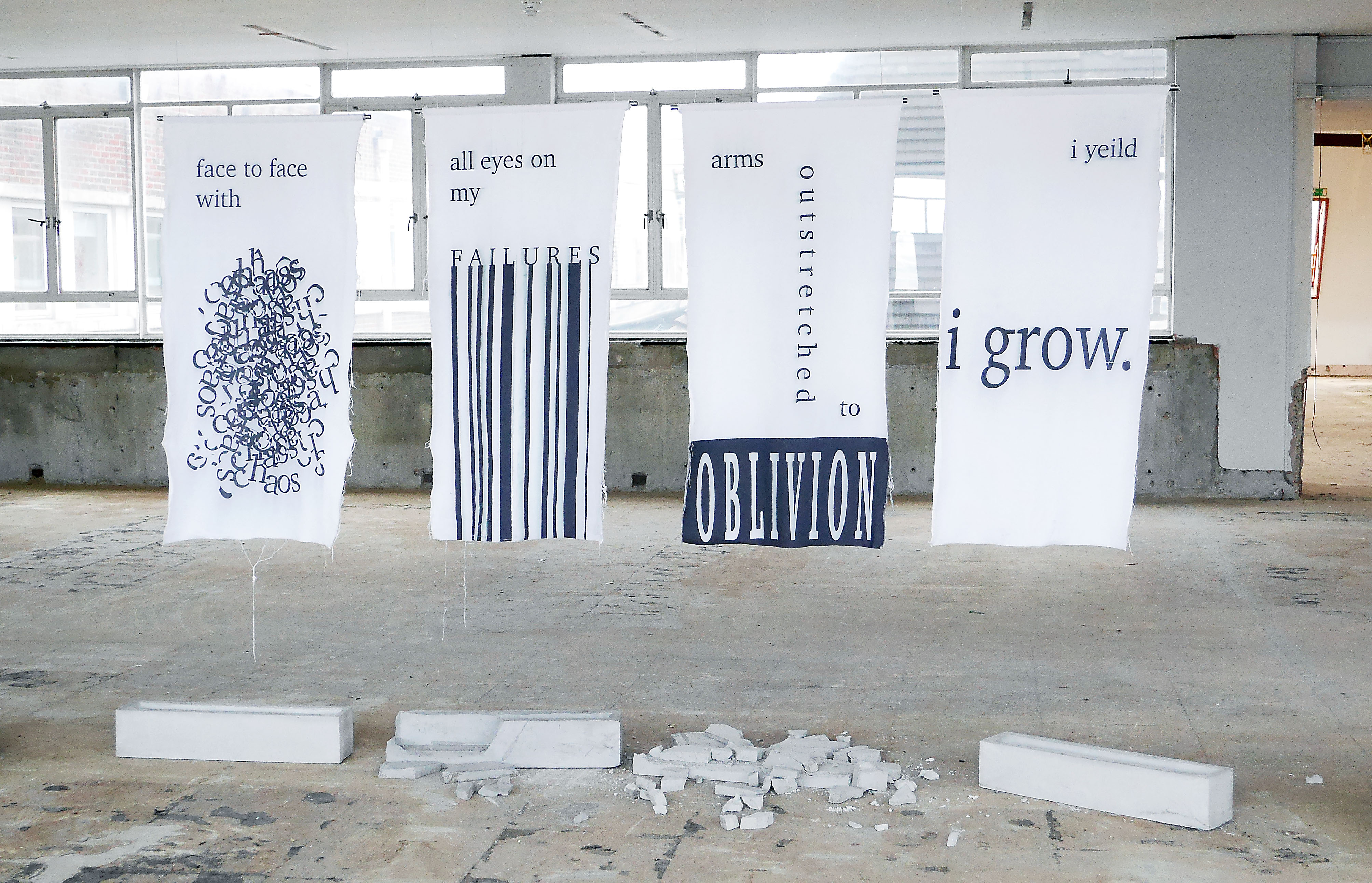

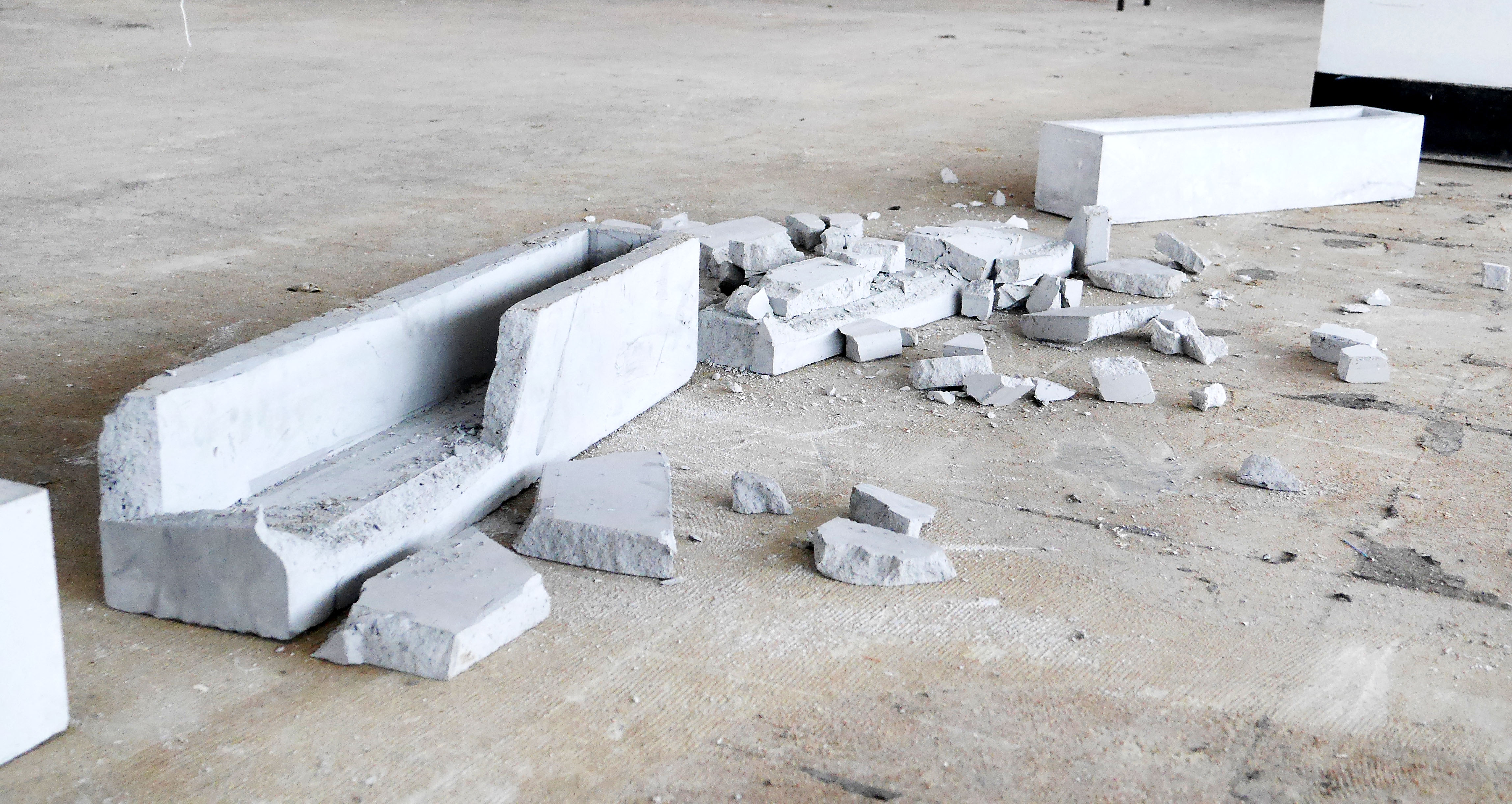
‘Oblivion’, 2023
cotton, ink, plaster
The work, as a whole, was transient. It felt caught between two states of being — not quite complete, but not really in need of anything to complete it either. The sheets swayed ethereally in response to the movement of bodies around them, whilst some of the printing ink had bled outside of its textual borders, giving the language a sense of fleeting inscription, like they were lifting from the cloth, very visibly to the material itself.
There was also something about the fragility and porosity of the plaster used to create the troughs. Despite being vessels, by means of their production they were rendered useless. There was something quiet, poetic, but also violent about their placement and state. There was a sense of balance, rejuvenation, destruction.
Contrary to the beguiling picture I’m painting of this work, I hated it. In some ways, I still hate it.
The cotton sheets were too small and not heavy enough to have the impact I wanted them to. Their ends were puckered and curled up, making the material look cheap and flimsy. The bleeding ink was messy, blotted with printing errors and the troughs had all cured slightly different shades of grey, carrying different degrees of moisture. Easy errors to correct with another iteration. But I dismissed it.
I threw away the troughs in a studio move. I recycled the metal and repurposed the cotton for use on another work.
I didn’t revisit the Acker text for some time. Despite the endearment I’d poured over it throughout my MFA, it was markedly absent from my final thesis.
I accepted defeat.
~
Some work, especially your own, takes time to grow on you. You have to sit with it, let it do its thing. Others, you’re just not ready for yet. Those are the ones that are hard to look at, hard to be around. But even if you can’t consciously face it, as Sin Wei Kin aptly put it in their recent panel talk at the Barbican — ‘sometimes our practices know things about us before we do’ 4. The nonconscious cognition5 is there all along, doing the heavy lifting.
Some months after the making and subsequent breaking of ‘OBLIVION’, I came out as non-binary. Just like my biceps, I realised, in order to grow anew it was necessary to break down what was already there.
I may not have been conscious of it at the time, but ‘OBLIVION’, imbued with its stolen, metamorphosed text, was the beginnings of this work. For the first time, through a language of the body no less, I was able to conceptually situate myself as something beyond the limitations that ‘ordinary language’ places on all of us.
To break away from the terms that delimit us from birth to death — a vagina and legs, a penis and shoulders.
Just like Acker’s legacy6 —
‘I’
the ‘I’ that bodybuilds
the ‘I’ that is the artist
the ‘I’ the writer
the ‘I’ the friend
the ‘I’ the partner
the ‘I’ the child
suddenly and easily
becomes more than just one bounded self.
Not merely a vessel, that by the means of its production is rendered useless, but something that is porous, plastic, shatterable, able to be realigned.
Sculpture may have been the process that I was finally able to understand my transness through, but it was bodybuilding — the intensely physical act of resistance, breakdown, repair — that enabled me to face that transness. Or perhaps more importantly, to question what it meant to be in possession of that transness.
For it’s this understanding of a continual closeness to failure, a continual striving for this ‘form of death’ in the face of perfection, or in other words total oblivion and movement through it — that is at the essence of trans experience.
Acker asks ‘is the equation between destruction and growth also a formula for art?’ 2. In so far as life imitates art, we could also ask — is transness a formula for art?
~
A year later, as I move closer to myself, Acker’s essay finally makes sense — and her adapted words sing.
‘Adapt’ would be the correct literary term. But I prefer ‘expand’. Semantics, one might say. But here, the semantics matter.
The definition of expand, according to Google, is:
There was also something about the fragility and porosity of the plaster used to create the troughs. Despite being vessels, by means of their production they were rendered useless. There was something quiet, poetic, but also violent about their placement and state. There was a sense of balance, rejuvenation, destruction.
Contrary to the beguiling picture I’m painting of this work, I hated it. In some ways, I still hate it.
The cotton sheets were too small and not heavy enough to have the impact I wanted them to. Their ends were puckered and curled up, making the material look cheap and flimsy. The bleeding ink was messy, blotted with printing errors and the troughs had all cured slightly different shades of grey, carrying different degrees of moisture. Easy errors to correct with another iteration. But I dismissed it.
I threw away the troughs in a studio move. I recycled the metal and repurposed the cotton for use on another work.
I didn’t revisit the Acker text for some time. Despite the endearment I’d poured over it throughout my MFA, it was markedly absent from my final thesis.
I accepted defeat.
~
Some work, especially your own, takes time to grow on you. You have to sit with it, let it do its thing. Others, you’re just not ready for yet. Those are the ones that are hard to look at, hard to be around. But even if you can’t consciously face it, as Sin Wei Kin aptly put it in their recent panel talk at the Barbican — ‘sometimes our practices know things about us before we do’ 4. The nonconscious cognition5 is there all along, doing the heavy lifting.
Some months after the making and subsequent breaking of ‘OBLIVION’, I came out as non-binary. Just like my biceps, I realised, in order to grow anew it was necessary to break down what was already there.
I may not have been conscious of it at the time, but ‘OBLIVION’, imbued with its stolen, metamorphosed text, was the beginnings of this work. For the first time, through a language of the body no less, I was able to conceptually situate myself as something beyond the limitations that ‘ordinary language’ places on all of us.
To break away from the terms that delimit us from birth to death — a vagina and legs, a penis and shoulders.
Just like Acker’s legacy6 —
‘I’
the ‘I’ that bodybuilds
the ‘I’ that is the artist
the ‘I’ the writer
the ‘I’ the friend
the ‘I’ the partner
the ‘I’ the child
suddenly and easily
becomes more than just one bounded self.
Not merely a vessel, that by the means of its production is rendered useless, but something that is porous, plastic, shatterable, able to be realigned.
Sculpture may have been the process that I was finally able to understand my transness through, but it was bodybuilding — the intensely physical act of resistance, breakdown, repair — that enabled me to face that transness. Or perhaps more importantly, to question what it meant to be in possession of that transness.
For it’s this understanding of a continual closeness to failure, a continual striving for this ‘form of death’ in the face of perfection, or in other words total oblivion and movement through it — that is at the essence of trans experience.
Acker asks ‘is the equation between destruction and growth also a formula for art?’ 2. In so far as life imitates art, we could also ask — is transness a formula for art?
~
A year later, as I move closer to myself, Acker’s essay finally makes sense — and her adapted words sing.
‘Adapt’ would be the correct literary term. But I prefer ‘expand’. Semantics, one might say. But here, the semantics matter.
The definition of expand, according to Google, is:
become or make larger or more extensive;
(of the universe) undergo a continuous change;
become less reserved in character or behaviour.
(of the universe) undergo a continuous change;
become less reserved in character or behaviour.
My partner recently asked me ‘what does transition feel like?’
I said,
‘expanse’.
Notes
- Acker, K. (1972). Politics. Papyrus Press, Chicago
- Acker, K. (1993). ‘Against Ordinary Language: The Language of the Body’, Bodies of Work, London: Serpent's Tail
- Grosz, E. (1994). Volatile bodies: toward a corporeal feminism. Bloomington: Indiana University Press
- Dohert, M. (2022). ‘Kathy Acker’s Art of Identity Theft’, Nov 28, 2022, New Yorker. (Available at: https://www.newyorker.com/magazine/2022/12/05/kathy-ackers-art-of-identity-theft)
- Wei Kin, S. (2023). ‘Sin Wei Kin & Planningtorock: Manifesting Alternate Realities’, Barbican
- Hales, K. (2019). ‘’Nonconscious Cognition’ & Kathy Acker’s ‘Language of the Body’’, Institute of Contemporary Arts London, (Available at: https://www.ica.art/learning/nonconscious-cognition-and-kathy-acker-s-language-of-the-body)
- McBride, J. (2022) Eat Your Mind: The Radical Life and Work of Kathy Acker, New York: Simon & Schuster
©Copyright AC Larsen 2026. All rights reserved.
mother
when you think about your younger self
and i’m talking specifically about those years that you’ve mentioned
those years you’ve repressed
specifically those years you really struggle with
struggle to think about
struggle to connect with
struggle to be present in any shape or form with
those years
picture those
in your mind
picture your body
picture your clothes
your presentation
note how you carry yourself
how you interact with yourself
hold that space
sit with it for a minute
sit with that person
those emotions
my butch lesbian therapist asks, over a slightly too milky cup of PG Tips, at 10 am on a saturday morning whilst i’m nursing a particularly potent vodka hangover
i’d like to say
dissociative, but in the disassociation I'm the ashy butt of a cigarette that’s just been casually flicked into the gutter—I have a smear of some left over rouge lipstick coagulated on the paper of my butt. I’m a very skinny also very chic variety of fag, like a vogue or a silk cut and I sit there in the fold of the curb with all of the other ashy fag butts of the morning commute looking cutesy but all the while knowning that it’s all a guise, a clever marketing gimmick and that my tar and toxins and the build up of all those fags that came before me are now clinging to that poor womans lungs, the poor woman who smoked me, a repository for years and years of this shit
but i don’t say this, for fear that my therapist will think I’ve officially lost it. So I say,
uncomfortable
***
My mother calls on my walk home.
How’s that cough darling? You don’t sound well. You’re overdoing it again. You should have some raw ginger and garlic. No, not on some pasta. You and your carbs honestly. Do you know what the glycemic index of white pasta is? Full of sugar. Just crush it up with a pestle and mortar. What? You don’t have a pestle and mortar? Fine, a grater will do. Mix it with some hot water and swill it down. And make sure you gargle it.
I hang up, exhausted. Coughing.
Asthma runs in our family. My mother has it and so does my brother. Mine started when I was around 4 years old. One day, I was fine, the next, paramedics were at the house. Casually popping me on a ventilator. So I wouldn’t die from lack of oxygen.
There’s no disease present. The doctors said. After I’d puffed into this tube and that. In my case, asthma was a convenient diagnosis for what they termed a capacity issue—which basically meant that my lungs were too small for the rest of my body. Underdeveloped. They couldn't process enough air for my greedy muscles.
Our doctor's advice was to take up a wind instrument, you know a trombone, a trumpet, one of the brass variety preferably. Apparently, discipling my breath, learning how to take big gulps in, timed to a beat, followed by strong, controlled exhales, would allow my lungs to strengthen and expand. Over time, and with a great deal of concerted brassy tantaras, this would eventually increase their puny capacity.
This was the same doctor who’d told my mother that stuffing her bra with cabbage leaves would cure mastitis. She ended up needing surgery for a breast abscess. I do question why we continued to go to this doctor, why eyebrows weren’t raised. But this was the NHS, in rural South Wales, in the 90s. And to be fair, taking up a wind instrument seemed like fairly innocuous medical advice in the grand scheme of things.
I think back on this on my walk. Coughing in two-step. My mother calls me a lot.
In many ways, she’s always viewed me as an extension of her. Her only daughter, after all. A term she’s yet to let go of. But what else am I supposed to call you? You’re not a child. You’re 30 years old. I can’t call a 30-year-old ‘my child’.
Pictures of us both as children are uncannily similar. The same strawberry-shaped face. Dimples. Freckles. Pigtails. Pinafores. Mum always says I take after my dad. But remember darling, intelligence is inherited through the mother. There was a Radio 4 segment about it.
Whether or not this particular claim is grounded in any rigorous science, or whether or not said Radio 4 segment actually exists (after all this statement was said in front of my regularly disparaged father) there’s certainly a long lineage of feminist philosophy engaged with notions of generational knowledge as passed down through the mother. Specifically through the mother-daughter line. As Virginia Woolf’s infamous line reads, ‘we think back through our mothers if we are women’ 1.
Cute. Sure, until that generational knowledge starts to muddy with generational trauma. What then?
Resisting the urge to fall into the easy liberal feminist trope of speaking for the masses, a common experience of ‘womanhood’ does seem to be, at some point, coming face to face with the idea of yourself as little more than a repository for your mother’s shit.
Whilst it might have been cute to compare the vision of me with my mother as a child for everyone else—playing dress up with pinafores and pigtails—as soon as I was cognisant of the gendered associations those comparisons were laden with, around 4 years old, I hated it.
I despised all of that performatively girly shit. I felt genuine abhorrence at the summer dresses we had to wear at school. Those shitty blue and white checked ones from Tescos and Asda. I detested the little frills on my white collar neck school shirts that Mum got me because she thought they were quaint. I raged at tights. Was filled with antipathy for the little gaps and buckles on my school shoes that somehow gendered them. I abhorred skorts. Abominated anything sparkly. Loathed entirely headbands. Bows. Cardigans and lace trim.
I remember one year, proudly announcing that I would like a denim jacket from Father Christmas. Michael J. Fox in Back to the Future idyllically affixed in my mind's eye. I can still feel the palpable dismay of my 8-year-old self, on Christmas morning, careering down the stairs. Seeing the jacket-shaped wrapping. Tearing through its seams. Only to sinkingly reveal. The jacket was pink. Isn’t it lovely darling, so feminine. Mum said. I coughed in the corner.
I may not have yet been versed in Butler or Sedgwick, but I was astute enough to understand that these aesthetic conditions, even at such a young age, were signifiers for something that ran far deeper than ponytails. I didn’t understand why I looked like that little girl of my mother's past, but didn’t feel like her.
There was nothing inherently offensive, from a material perspective, about the lace trim lining my M&S cotton socks, even if they were a little dowdy. It was the politics that were embedded within that material that was the issue. The politics embedded in what that material represented when mapped onto my femaleness. And most pertinently, the politics embedded within the kick I got from folding them inside out as soon as I was on the school bus.
***
After the potentially questionable clinical advice, the next Saturday, Mum drove me two hours to a second hand brass instruments shop.
I remember climbing out of our purple Ford Galaxy, Mum taking my hand and walking me up to the threshold, where she crouched down to eye level and said, just choose the one that speaks to you the most darling. Mum often favours these profound embodied statements, but, ever the pragmatist, off I popped to look for a talking trumpet.
There were piles and piles of instruments. The top shelfers sat proudly in a dusty velvet display case at the front of the shop, marked inquire for price. Black and white pictures of famous jazz musicians were propped up behind them, adding to their sense of reverence. The mid-rangers lined the walls, sitting precariously but majestically atop bashed-in nails. Little hand-scrawled price tags with the year of original manufacture and maker dangled proudly from their tubes. Then, lining the floor along all four walls, were the bargain bins, which, probably to my mother's delight, I instantly gravitated towards.
These crates were filled with odd bits and bobs, unsalvageable parts, dented and mangled valves. Cast-off piccolo trumpets in piles and flugelhorns just a little too weathered for the wall or the display case spilt out onto the floor. Perhaps I was drawn to their inherent sense of unsalvageability. Their brokenness mirroring my recently diagnosed incapacities. Or maybe ToyStory was fresh in my mind and I was particularly empathetic towards these spent band members.
Atop the bin furthest from the cashier display case, marked misc, I spotted my prize—a battered little cornet. Sporting a muddy ochre tint, formed from years of handling, it had lost its once golden brassy gloss. It was dented with drop marks on its bell and its valves were thin and worn away. Some of its tubes had been replaced with parts of other instruments, with blobs of silver lining its lead pipe and valve tuning slides. It felt discarded but in a loving, gentle way.
this one.
***
Mum loves music. She played the bagpipes as a child. She still has a pair. Sometimes she gets them out on Burns Night. Just before the veggie haggis is served she’ll squeeze out a spluttery and heavily punctuated rendition of Scotland the Brave, which is met by staggered polite claps and a hasty Sláinte! The other 364 days of the year, the pipes live in the attic, cohabiting with the dust and power tools.
Some of my favourite childhood memories are of Mum picking me up from nursery. It would just be me and her for the whole afternoon. She’d make me cheesy pasta with quorn pieces and peas and we’d practise times tables and spelling (which we were both shit at—go figure). Then Mum would throw on my Dad’s old vinyl player. Splish Splash by Bobby Darin. Blue Moon by Billie Holiday. Hound Dog by Elvis Presley. We’d shake our tail feathers in whichever room needed a spruce up that day, me brandishing my kiddy-sized feather duster, Mum the antibac.
It’s hard to give form to that slow realisation, during the creep towards adulthood, that your parents actually had a life before you. I remember thinking that Mum must have lived forever. What was it like in the Victorian era? I asked once without even a hint of sarcasm.
I’m not a parent. So I don't know how much of yourself you compartmentalise when you become one. How much of yourself you lose. It seems like a lot.
Mum recently got out some old pictures to show me and my partner. Wild house parties in the 70s. Skiing holidays in the 80s. Go-go boots and shoulder pads galore. You know darling, Mum said as she flipped through some pictures of what looked like a particularly raucous New Year’s Eve in her early twenties, I haven’t got the faintest idea who any of these people are.
***
Mum drove me to my cornet lesson every Tuesday night. I soon got the hang of the pursed-lip technique. I took to the hand-breath coordination like a natural. I learnt Happy Birthday. Away in a Manger. I Saw Three Ships. Old King Cole. It won’t be long before you’re blowing the house down with Miles Davis darling, Mum said.
I moved through grades 1 and 2 with ease. I joined an orchestra band our neighbour’s kids went to. Mum drove me there on Saturday mornings. All the other kids had new, shiny, top-of-the-range brass, wind, strings and percussion. My battered, discoloured, dented squashed trumpet-like thing stuck out like a sore thumb. The other kids laughed, but I was proud of it. It made a great sound, despite my puny lungs.
We’d always get a cupcake afterwards from the bakery counter in Sainsbury’s. I liked the ones with marzipan animals on top.
But despite the pernicious renditions of Greensleeves, the asthma attacks persisted. Our doctor was not enthused by the progress I was making towards improving my capacity issue.
Your peak flow test results are still not great. Your lungs aren’t increasing in size. Maybe try a tuba instead?
Mum consoled me. It will just take time darling. Keep going. You’re doing great. Your lungs will catch up.
My lungs didn’t catch up.
I passed the benchmarks where they said I’d ‘grow’ out of it. Mum took me to a homoeopath. An osteopath. We tried the Alexander Technique. Reiki. Sound healing. Acupuncture. My peak flow results remained firmly below average. I started carrying an inhaler to school. Puberty hit. I gave up the cornet playing and reluctantly embraced the skorts. I laid down with the idea of becoming a woman that I was given. That my friends were so excited about, that I couldn’t understand.
My tired cornet in its soft case rested under my bed. Gathering the dust that was triggering my lungs.
***
‘One is not born, but rather becomes, a woman’,3 another infamous line with crucial significance for both Western feminism and queer theory, delivered by Simone de Beauvoir in The Second Sex.
Beauviour eloquently summarised, in one quick quip, the long-standing feminist effort to divorce the female body, and female experience, from notions of biological determinism. That is, assigned sex at birth does not preclude gender or gendered assumptions of what one is capable of being or becoming. Hugely important for female liberation, and trans liberation, this notion asserts that fundamentally, having what one perceives to be, or clinically determines to be, a sexed body, in this case a female one, does not necessitate becoming a ‘woman’ in the patriarchal definition of the word. This becoming occurs via culture, socialisation, language, and oppression.
Thinking about this in relation to Woolf’s assertion ‘we think back through our mothers, if we are women’ — it is the conditional ‘if’ that becomes the sticking point. To think back through our mothers then, is conditional on us becoming the Western philosophical definition of ‘woman’ — the version of woman and that pained stereotypical femininity that our mothers are or were constrained by and fought against. The same idea that the female liberation movement has long resisted. The same idea that ironically, many of our mothers wish for us to become.
Jack Halberstam explores this idea in The Queer Art of Failure, drawing on the Beauvoirian feminist framework and inverting it to argue for a form of feminism that is rooted rather in a sense of ‘unbecoming’3.
Halberstam asserts that by ‘refusing to think back through the mother’ we are refusing to ‘become woman as she has been defined and imagined within Western philosophy’. By breaking the hereditary link that forces the daughter (or anyone with an assigned female experience) to co-opt notions of woman that productively engage with heteronormative, reproducible patriarchal power, we are imagining ourselves as an embodiment of more than a repository for generational oppression.
Basically, more than our mothers, and their mothers’, shit.
Halberstam draws on Saidiya Hartman’s pioneering text, Lose Your Mother 4 to advocate for this unbecoming feminism — ‘losing one’s mother [...] actually enables a relation to other models of time, space, place, and connection.’ That other also being experiences that aren’t rooted in white, cisgendered, heteronormativism.
I’ve been thinking about this a lot recently in relation to my ongoing ‘capacity issue’, my lungs that are unable to reach their ‘full inhalation potential’. I’ve long given up on doctors, simply accepting that a few times a year my breathing stops. But all of that blasting out Greensleeves was about increasing their capacity. Conditioning my body, one C major at a time to become—larger, more developed, stronger, controlled. To have the capacity to take in more, absorb more, embody more.
But what if my capacity issue wasn’t about needing to become at all. What if it was actually about needing to unbecome.
Or to think about it in less philosophically grandiose terms—to breathe properly, I needed to get rid of some shit.
***
My mother detests smoking. Detest is in fact too soft.
Detest, in fact, is far too linguistically soft. There is no combination of words in the English language, to my knowledge, that can communicate the brevity of disgust this woman feels towards smoking. Which is either heavily ironic or perfectly reasonable, considering that she smoked for twenty years.
Anyone within a 10-metre radius will hear about it if my mother so much as whiffs the passing gust of a cigarette. I’ve witnessed this woman shout down smokers outside of train stations, wear a balaclava to a beer garden, storm out of restaurants and cross streets, all over so much as a whisper of fag smoke.
One time, when I was about 17, she found a loose cig in one of my jumpers when putting it in the wash. She didn’t speak to me for 3 weeks.With your lungs, really? After all of those renditions of Greensleeves?
I’d first started smoking when I was 16, having long given up on improving the capacity issue. this was around the same time that I was doing anything and everything I could think of to feel anything at all. I began to become drawn to anything that mirrored my own brokenness, my own inherent sense of unsalvageability. It’s hard thinking about that person, the partying, the recklessness, the point where youthful hedonism gave way to nihilism, the lack of care they had for themselves. the lack of love.
The years 16-21 are the worst. Blurry to the point of indiscriminate, chunks of timeline are disassociated from memory. Bitten off and spat back out into the space-time continuum. I’ll never forget the phone call I made at 2 am, the night the suicidal ideation had reached its peak.
Mum, I can’t stop thinking about hurting myself.
Mum drove 6 hours to pick me up.
*
Mum quit smoking with a somewhat unusual method. For one month, she placed every fag end that she’d smoked into a jar of water. After a months supply of fags (fuck knows how big this jar was) she sealed the lid and watched the toxins dissipate into the increasingly blackening water. Everytime she craved a cig from there on out, she’d look at the jar, or picture it, and imagine all that shit sticking to her lungs.
Albeit unconventional, the jar method was effective. Mum hasn’t had as much as a drag since. Not so much the result of the method, but more, I think, because of the strength of her stubbornness. If my mother decides to do something, I'll be damned darling, she’ll do it.
It’s interesting that I quit smoking (save that occasional weekend delight) by unknowingly adopting the same method. I was living in a house shared with 3 other people and was the only smoker. We had a postage stamp garden that was never used apart from my evening light-up. At the end of the tenancy, I went out there to sweep up, for the first time in the daylight. Hundreds of cigarette butts littered the floor, oozing away in probably an inch thick of sticky black gunk. The immediate visual was enough to kick the habit cold turkey, shut the door and accept the deposit reduction.
I didn’t know at the time, but suicidal ideation is a perfectly normal response to extreme distress and dysphoria. In my case, the distress of performing a version of myself, a version of woman, that was anything but biologically determined.
It’s this same shit, oozing on the back step, that comes to mind when I think about that younger self. Those years of breathing in the context of what was expected, what was given. The osmosis of those projected versions of becoming. Maybe one day I’ll be able to write something that talks about excavating all of that shit, or at least learning how to breathe a little easier with it.
But for now, it’s enough to simply recognise that those fag ends exist. To appreciate that those past selves didn’t have the capacity to understand, despite their draw to the misc section of the instrument shop.
That little girl did the best she could with the music she was given, yet still, somehow—along the way—she managed to make a far more beautiful melody.
***
The weather is turning now. It’s getting colder, the air drier. My chest always flares up this time of year.
My mother calls on my walk home.
Hi darling, did you listen to the Radio 4 segment I sent you?
I hang up. Smiling.
Notes
- Woolf, V. (1929). A Room of One’s Own, Hogarth Press, London
- Beauvoir, S. (1964). The Second Sex. Penguin Vintage Classics, Reprint 2015, London
- Halberstam, J. (2011). The Queer Art of Failure. Duke University Press, Durham and London
- Hartman, S. (2007). Lose Your Mother: A Journey Along the Atlantic Slave Route, Farrar, Straus and Giroux, New York
©Copyright AC Larsen 2025. All rights reserved.
give us our roses while we’re still here
When I was recovering from top surgery, our flat was filled with flowers. There were flowers in the kitchen, flowers in the bathroom, flowers in the bedroom, flowers on the floor, flowers in the hallway, flowers on the sink, flowers on the windowsills. So many flowers. I’d never seen so many flowers. Save at a wedding or a funeral or a wake or something similarly memorial, which was, in fairness, quite fitting—given that days prior, part of me, my body, had been sliced off and thrown in a medical waste incinerator, to be returned to the earth at some future point.
With every new bunch of flowers that arrived, in a monolith M&S box dumped on our welcome mat, or a coy flatpack thrust through the letterbox—I’d spend ages arranging and rearranging—plucking each stem out individually and inspecting it thoroughly, feeling its weight in each hand, pressing it up into my nostrils, mentally debating it’s particular shade of ochre, orchid, was it cream or magnolia? After much deliberation and perusal, I would then delicately, graciously, bequeath it to its new bountiful vase, where it would remain amongst friends for the next two weeks until rotten. This plucking, sniffing, weighing, debating, arranging, then rearranging, became one of my favourite daily activities—a ritual of sorts, something to keep my semi-incapacitated T. rex arms busy, a welcome reprieve from Netflix and the 2000-piece cat puzzle I’d also been bequeathed.
Some of the flowers were from friends whose silence over the past few months has been blinding. A silence which has permeated private spaces, as our right to exist as trans people in the UK has become more and more quashed, our access to public space more and more restricted and suffocated. Maybe the flowers were a gesture of recognition, a non-verbal offering imbued with reconciliation via universal material language.
Or maybe they were reflective of the fact that this particular flavour of self-elected aestheticising violence, done unto my body by way of incredibly expensive plastic surgery, and my current somatic incapacity, was a language that they understood. A tangible thing that had happened to me, a tangible incident to recovery ratio or narrative arc. Tangible in a way that the unknowability of implicit violence, this wry thing which has no immediate or discernible shape, no rough edges to cling onto, that manifests as a girding undercurrent, a tout pique feeling—that is transphobia, was not. Either way, I appreciated the flowers (and the cat puzzle) as objects separate from these laden feelings—temporary, fragile, strong, poised.
As each bunch blossomed, drooped, shrivelled and greyed, the trite metaphors aplenty for my dead tits reverberated around the house. It’s a very strange feeling to know that something once attached to you, your tissues, is dead. Trans people, on average, have a shorter lifespan than cisgender people. The exact figures remain elusive because there’s obviously hardly any scientific studies done or data collected on trans people ever, but numerous studies and articles I researched quoted that it is significantly less.
One paper I read said:
‘Mortality among transgender and gender diverse persons may be higher than that of cisgender persons because of increased risk of external causes of death and deaths due to illness. The minority stress model posits that chronic stress due to repeated exposure to violence, discrimination, economic and social marginalisation results in greater vulnerability to poor health outcomes and mortality among transgender individuals globally. Transmasculine persons have a higher mortality from external causes of death than cisgender women.’ 1
My lifespan is shorter than the lifespans of those friends who couldn’t be bothered to send a text.
I don’t really worry about dying from a violent attack. Maybe that’s ignorance and certainly a level of white male privilege that I can now sometimes slip into as long as I don’t open my mouth or smile or draw attention to my girly dimples in the wrong places, but also statistically, out of all gender non-conforming people I’m only 4% likely to die from a violent transphobic attack. But then, when you also add misogyny and violence against women to the mix, the odds do go up some, but I think I’m still statistically okay. I do worry about my trans-femme friends dying from violent attack, as out of all trans people, they are 96% likely to, which is so abominably high I don’t know what to do with that kind of statistical information.
I also worry about the minority stress model. I worry that my heart or blood vessels, or some kind of tissue matrix, won’t be able to take it. That one day I’ll be: one more disgust stare from a middle aged man on the tube; or one more security guard storming into the ladies toilet to manhandle me away mid piss; or one more ‘dyke’ spat at me in front of rose pharmacy where I’m innocuously trying to pick up my prescription; or one more drunk guy asking me if I’ve got a pussy or a dick outside Highbury station at 7:00 am on a Tuesday; away from a fatal aneurism. It does worry me, the minority stress model striking midnight.
Sometimes being trans feels like being constantly surrounded by little deaths. I chose death for my breast tissue, now incinerated to an ashy pulp in a bin somewhere in W1. I chose death for my given name, which lingers now only on my Tesco’s Club Card because I refuse to give up the many meal deal points it has accumulated over the last decade that I’m still yet to see any real monetary value from. I chose death for friendships and family ties that refuse to recognise me in my fullness, or that lack the capacity to see that fullness anew. I choose death every time I crush my body into failure at the gym, pulverising my womanlyness in an Acker-esk obliteration of self.
But through all these deaths, these little incommensurate deaths, I choose life, life so beatific and real. I choose a very expensive, plastic chest rendered with sinew and decorated with scar tissue that somehow frees me. I choose a totally fabricated name that I have to constantly reiterate that no, it’s not an initial and yes two two-letter names are a thing, that somehow delineates me. I choose a body built form comprised of coagulated and ultra-processed protein powders, which somehow affirms me.
There is nothing about me which isn’t artifice, wholly performative, completely unnatural and always in abject opposition to what others and my own internal DNA provided for me. But that plastic-y artifice is life, and I choose it again and again and again, and I wonder, with each moment of pure, unadulterated, charlatan joy, how many years I’m adding to my lifespan.
Gender affirming surgeries have the lowest regret rates for any kind of surgical intervention2.
Google Gemini tells me—sending flowers is a good way to express regret.
Notes
With every new bunch of flowers that arrived, in a monolith M&S box dumped on our welcome mat, or a coy flatpack thrust through the letterbox—I’d spend ages arranging and rearranging—plucking each stem out individually and inspecting it thoroughly, feeling its weight in each hand, pressing it up into my nostrils, mentally debating it’s particular shade of ochre, orchid, was it cream or magnolia? After much deliberation and perusal, I would then delicately, graciously, bequeath it to its new bountiful vase, where it would remain amongst friends for the next two weeks until rotten. This plucking, sniffing, weighing, debating, arranging, then rearranging, became one of my favourite daily activities—a ritual of sorts, something to keep my semi-incapacitated T. rex arms busy, a welcome reprieve from Netflix and the 2000-piece cat puzzle I’d also been bequeathed.
Some of the flowers were from friends whose silence over the past few months has been blinding. A silence which has permeated private spaces, as our right to exist as trans people in the UK has become more and more quashed, our access to public space more and more restricted and suffocated. Maybe the flowers were a gesture of recognition, a non-verbal offering imbued with reconciliation via universal material language.
Or maybe they were reflective of the fact that this particular flavour of self-elected aestheticising violence, done unto my body by way of incredibly expensive plastic surgery, and my current somatic incapacity, was a language that they understood. A tangible thing that had happened to me, a tangible incident to recovery ratio or narrative arc. Tangible in a way that the unknowability of implicit violence, this wry thing which has no immediate or discernible shape, no rough edges to cling onto, that manifests as a girding undercurrent, a tout pique feeling—that is transphobia, was not. Either way, I appreciated the flowers (and the cat puzzle) as objects separate from these laden feelings—temporary, fragile, strong, poised.
As each bunch blossomed, drooped, shrivelled and greyed, the trite metaphors aplenty for my dead tits reverberated around the house. It’s a very strange feeling to know that something once attached to you, your tissues, is dead. Trans people, on average, have a shorter lifespan than cisgender people. The exact figures remain elusive because there’s obviously hardly any scientific studies done or data collected on trans people ever, but numerous studies and articles I researched quoted that it is significantly less.
One paper I read said:
‘Mortality among transgender and gender diverse persons may be higher than that of cisgender persons because of increased risk of external causes of death and deaths due to illness. The minority stress model posits that chronic stress due to repeated exposure to violence, discrimination, economic and social marginalisation results in greater vulnerability to poor health outcomes and mortality among transgender individuals globally. Transmasculine persons have a higher mortality from external causes of death than cisgender women.’ 1
My lifespan is shorter than the lifespans of those friends who couldn’t be bothered to send a text.
I don’t really worry about dying from a violent attack. Maybe that’s ignorance and certainly a level of white male privilege that I can now sometimes slip into as long as I don’t open my mouth or smile or draw attention to my girly dimples in the wrong places, but also statistically, out of all gender non-conforming people I’m only 4% likely to die from a violent transphobic attack. But then, when you also add misogyny and violence against women to the mix, the odds do go up some, but I think I’m still statistically okay. I do worry about my trans-femme friends dying from violent attack, as out of all trans people, they are 96% likely to, which is so abominably high I don’t know what to do with that kind of statistical information.
I also worry about the minority stress model. I worry that my heart or blood vessels, or some kind of tissue matrix, won’t be able to take it. That one day I’ll be: one more disgust stare from a middle aged man on the tube; or one more security guard storming into the ladies toilet to manhandle me away mid piss; or one more ‘dyke’ spat at me in front of rose pharmacy where I’m innocuously trying to pick up my prescription; or one more drunk guy asking me if I’ve got a pussy or a dick outside Highbury station at 7:00 am on a Tuesday; away from a fatal aneurism. It does worry me, the minority stress model striking midnight.
Sometimes being trans feels like being constantly surrounded by little deaths. I chose death for my breast tissue, now incinerated to an ashy pulp in a bin somewhere in W1. I chose death for my given name, which lingers now only on my Tesco’s Club Card because I refuse to give up the many meal deal points it has accumulated over the last decade that I’m still yet to see any real monetary value from. I chose death for friendships and family ties that refuse to recognise me in my fullness, or that lack the capacity to see that fullness anew. I choose death every time I crush my body into failure at the gym, pulverising my womanlyness in an Acker-esk obliteration of self.
But through all these deaths, these little incommensurate deaths, I choose life, life so beatific and real. I choose a very expensive, plastic chest rendered with sinew and decorated with scar tissue that somehow frees me. I choose a totally fabricated name that I have to constantly reiterate that no, it’s not an initial and yes two two-letter names are a thing, that somehow delineates me. I choose a body built form comprised of coagulated and ultra-processed protein powders, which somehow affirms me.
There is nothing about me which isn’t artifice, wholly performative, completely unnatural and always in abject opposition to what others and my own internal DNA provided for me. But that plastic-y artifice is life, and I choose it again and again and again, and I wonder, with each moment of pure, unadulterated, charlatan joy, how many years I’m adding to my lifespan.
Gender affirming surgeries have the lowest regret rates for any kind of surgical intervention2.
Google Gemini tells me—sending flowers is a good way to express regret.
Notes
- S.S Jackson, J. Brown, (2023) ‘Analysis of Mortality Among Transgender and Gender Diverse Adults in England’, JAMA, Vol 329, P2145
- S.M Thornton, A. Edalatpour, K.M. Gast., (2024) ‘A systematic review of patient regret after surgery - A common phenomenon in many specialities but rare within gender-affirmation surgery’, American Journal of Surgery, Vol 234, P68-73
©Copyright AC Larsen 2025. All rights reserved.